The 19th Cinema Haqhiqhat Festival Opened with a Maternal Scent
The 19th Cinema Haqhiqhat Festival opened at the Mellat Cinema Complex. To mark Mother’s Day, the documentary film “Her Name is Woman” by Maria Maouti was screened, showcasing a remarkable image of love and humanity through the women of Iran.
the opening ceremony of the 19th Cinema Haqhiqhat Festival took place this afternoon at the Mellat Cinema Complex. The event was attended by Mohammad Hamidi Moghaddam, the festival secretary, the selection advisory board, Palestinian documentary filmmaker Rashid Masharawi, and several documentary film industry professionals.
The coincidence of the ceremony with the night of the birth of Lady Fatima Zahra (PBUH) provided an excellent opportunity to honor women. On this occasion, Amin Ghedami, the program host, requested that the attendees stand and applaud the women in honor of the esteemed position of mothers.
Ghedami noted that this year’s Cinema Haqhiqhat Festival is the first documentary event after the 12-day war, saying: “We had a year of ups and downs. We must pay our respects to everyone who sacrificed their lives during the 12-day war, from the soldiers who stood behind the launchers to the bakers who worked two shifts, and the filmmakers who documented the scenes and events of the war.”
He continued: “Cinema Haqhiqhat reflects the realities of the world. This year’s festival showcases a diverse reflection of various topics. The films in this festival cover a wide range of social, cultural, and other issues.”
Following this, clips introducing the festival’s various documentary sections were shown, and Mohammad Hamidi Moghaddam, the secretary of the 19th Cinema Haqhiqhat Festival, was invited to the stage.
Documentary Cinema is Not a Cinema of Silence
Hamidi Moghaddam stated: “I am happy to open the 19th Cinema Haqhiqhat Festival on the blessed night of the birth of Lady Fatima Zahra (PBUH), Mother’s Day, and Women’s Day. The 19th Cinema Haqhiqhat Festival is the result of the hard work of many documentary filmmakers—a gathering as vast as the great land of Iran. I hope this bond and shared experience will be full of memorable moments for all of us.”
He continued: “Today, the world has acquired new features, as wars, conflicts, violence, threats, and boundaries have given new meaning to life, relationships, and even borders. The human being, entangled in ethical crises, strives in this world of injustice for a new understanding of ‘life, freedom, and peace.'”
Hamidi Moghaddam emphasized that documentary cinema is a cinema of demand, saying: “Cinema Haqhiqhat is the platform where works inspired by this noisy world are displayed. Documentary cinema is critical, inquisitive, and demanding; it is the cinema of seeing, analyzing, and searching for meaning. The 19th Cinema Haqhiqhat Festival begins in a time where we have tried to reflect these transformations and changes.”
He went on to say: “We are opening the Cinema Haqhiqhat Festival while the memory of the blatant aggression by the Zionist regime is still fresh, and the sacrifices of the martyrs of this recent crime are still vivid. This is the first documentary event after the 12-day war, and we felt it was our duty to honor ‘Iran’—the land that has repeatedly been the target of jealousy and hatred from adversaries but has managed to overcome these crises with the help of its people.”
Hamidi Moghaddam added: “The open and covert threats against Iran continue, and what is necessary is the preservation of national unity and cohesion. Cinema Haqhiqhat 19 strives to reflect the spirit of today’s Iran, its beauties, its marvelous nature, its men and women, its history, its pride, and the epics that shape our ‘collective identity.’ It also looks to tomorrow, the tomorrow that the younger generation will build.”
Honoring Women and Mothers
Referring to the arrival of Mother’s Day, he said: “This opening ceremony is dedicated to mothers and women. In the past two years, we have paid tribute to the mothers and children of Gaza, and we have not forgotten that we witnessed one of the most horrific genocides in history. Documentary cinema is not a cinema of silence. In honor of all mothers and women in Iran and all martyrs’ mothers, especially those who died in the attacks by the Zionist regime in Iran, Palestine, and Gaza, we wish peace and tranquility for all people of the world. Documentary cinema will remain a recorder of common achievements, history, culture, and humanity, far from violence and human suffering.”
Appreciating the Festival’s Selection Advisory Board
In another part of the ceremony, the members of the festival’s selection advisory board were also honored. Hamidi Moghaddam thanked the advisory board, saying: “I would like to thank the advisory board for their hard work. With external consultants, they reached about 25 members and spent nearly a month watching films.”
Rashid Masharawi’s Remarks
Rashid Masharawi, a renowned Palestinian filmmaker, was another speaker at the ceremony. He said: “I am very happy to be here tonight, and I feel like I am at home. I congratulate the beginning of the 19th Cinema Haqhiqhat Festival, and I believe it will be a successful event.”
He continued: “I am a big fan of documentary cinema, and dozens of my feature films have been shown worldwide. I established the Masharawi Fund to help and support filmmakers in Gaza, which has produced 32 documentary films so far. The importance of Gaza documentaries for us is that through them, we were able to show the numbers. The media report that hundreds or thousands of people have been martyred in war, but these numbers are just figures with little meaning. Documentary films helped us transform these numbers into people—people who had dreams but were deprived of them.”
Masharawi emphasized: “Documentary films in Palestine have also helped us in other ways. They have allowed us to remember our identity, past, and history in Palestine.”
Honoring Gaza at Cinema Haqiqat
He thanked Hamidi Moghaddam for the Gaza section of the festival, saying: “I want to thank Mr. Hamidi Moghaddam for the Gaza section of the festival. We had a joint production with the center, and he always told me that they supported us and never withdrew their support. I am happy to see today that these joint productions have come to fruition. Joint film production is a good start for us because we share many other commonalities besides films, and that is the outcome of this war.”
Screening of “Her Name is Woman”
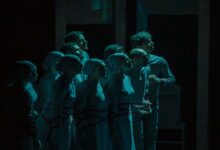
At the end of the ceremony, the documentary film “Her Name is Woman” by Maria Maouti was screened. This documentary offers a unique perspective on the situation at the Amneh Orphanage during the 12-day war and was selected as the opening film for Cinema Haqhiqhat in honor of Mother’s Day.
Maouti, who was present on stage with some of the film’s subjects for a tribute, said: “The documentary ‘Her Name is Woman’ is not a film about war; it is completely anti-war. The essence of the film is something I deeply believe in, and that is that Iranian mothers and women are symbols of resistance, love, and humanity. In the war, they not only did not go silent, but they did not even fade away.”
She continued: “I was astonished by the women I met in Shibr. I was amazed by their kindness, and the result of that was the film ‘Her Name is Woman.’ I remember sitting in the orphanage guardhouse when one of the women working there brought a newborn who had been born on the second day of the war. I was stunned by that newborn, took a photo of it, sent it to Mr. Badrloo, and said, ‘Please let me make this film with the Center for Development.’ Thank God this film was made to show the love and humanity of Iranian women.”